
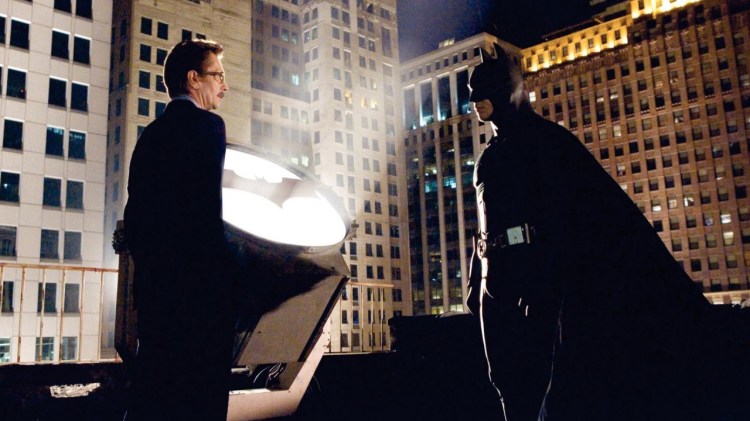
There’s a specific kind of whiplash you get from pop culture. For me, it was watching Batman Forever and Batman Begins a decade apart in the same exact theater. My first big-screen Batman experience was a circus of neon lights and Jim Carrey’s manic energy. It was… a time. But it wasn’t my Batman. My Batman was the shadow from The Animated Series, the brooding, brilliant detective. He was the tortured soul from Tim Burton’s gothic masterpiece, Batman Returns, which to this day still holds the top spot for me. But in 2005, sitting in that same theater, Christopher Nolan delivered something so raw and so real that it came dangerously close to knocking Returns from its top spot.
What I got instead changed everything. It wasn’t the grim atmosphere or the thundering score that floored me, though both were incredible. It was the man inside the suit. For the first time, I saw a hero who was not just flawed, but completely and utterly broken. Twenty years ago this month, Nolan gave us a Batman movie that wasn’t just about a superhero. It was about a man. And in doing so, it taught me that our heroes could be just as scared, lost, and human as the rest of us.

More Man Than a Bat
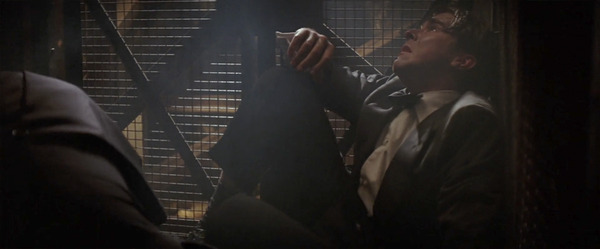
Let’s be honest though. The real genius of Batman Begins is how much it isn’t about Batman at all. It’s about Bruce Wayne. And I’m not talking about the suave, billionaire playboy persona he puts on for the public. The movie strips that all away and shows us the raw nerve underneath. We spend a massive chunk of the runtime with a young Bruce who is adrift in the world, simmering in a stew of his own rage and grief. He’s not training for a heroic destiny; he’s trying to lose himself, to understand the darkness that swallowed his life by becoming a part of it. When he lands in that foreign prison and gets thrown into a brawl, he isn’t fighting for heroic purpose. He’s just a guy letting out his demons.
Christian Bale’s performance is key here. He plays Bruce with a desperate, almost feral energy. This isn’t a hero in waiting. This is a man who has completely lost his way. The chilling confrontation with Carmine Falcone in the club says it all. Falcone dismantles Bruce’s privileged worldview, spitting, “You think because you’ve been slumming it, you know the world… You’re just a man in a suit.” At that moment, he’s right. Bruce is nothing more than a lost boy playing dress up, fueled by a rage he can’t control. And showing us that weakness, that utter deconstruction of the hero, is what makes his eventual rise so powerful.
Weaponizing Fear, Forging a Hero
From there, the movie zeroes in on the one thing that truly defines this version of the character: fear. Most superhero movies treat fear as an obstacle to be conquered and forgotten. For Bruce Wayne, fear is the entire point. It’s his origin, his motivation, and ultimately, his greatest weapon. The movie constantly reminds us of his trauma. The fall into the well, the swarming bats, the opera, the gunshots in the alley. These aren’t just backstory; they are the ghosts that haunt every frame of the movie.
His journey with the League of Shadows isn’t about learning to fight; it’s about learning to control his own terror. Then comes the single most important moment of Batman Begins. A scene that still gives me chills. Bruce, back in the cave, faces the very symbol of his childhood trauma. He stands there, resolute, as a cyclone of bats engulfs him. He doesn’t flinch. He doesn’t run. In that moment, he’s not just conquering his fear; he’s harnessing it. “I shall become a bat.” It’s an insane declaration, but it’s the most pivotal character beat in the superhero movie history. He chooses to turn his deepest psychological wound into a symbol of hope for others and a symbol of terror for the criminal underworld. This makes his conflict with Scarecrow so brilliant. It isn’t just fists and gadgets; it’s a philosophical war over the very nature of fear itself.
Here’s the other thing Batman Begins gets right about building a human hero: he doesn’t do it alone. A god, like Superman, doesn’t need help. But a man? Bruce, Batman, does. Bruce is brilliant and driven, but he would have failed spectacularly without his support system. He needs people to keep him grounded and to remind him of the humanity he’s fighting for. You have Lucius Fox (Morgan Freeman) making the fantasy feel real. You have James Gordon (Gary Oldman), a symbol that the city is worth saving.
And then there is Alfred. Michael Caine’s performance is the absolute soul of the entire trilogy. He isn’t a butler; he’s Bruce’s father, his conscience, and his rock. He’s the one who patches him up, calls him out on his nonsense, and delivers the line that defines the entire ethos of the movie: Why do we fall, sir? So that we can learn to pick ourselves up.” Heroes aren’t born. They are made. They are forged in failure.
Shadow of The Dark Knight
And yes, I know the argument. The Dark Knight is considered the best of the trilogy by most. It’s an immaculate crime thriller that gave us Heath Ledger’s iconic, lighting-in-a-bottle performance. But I don’t consider it to be the best Batman movie. It’s the best Joker movie. The entire movie rightfully bends to the gravity of his chaos, and Batman is often a supporting player in his own story. Batman Begins, however, belongs completely to Bruce Wayne. It’s a character study from the ground up, more interested in the psychology of its hero than the scale of its spectacle. It is quieter, more focused, and for my money, a much deeper Batman movie.
Twenty years later, that’s why it still hits so hard. In a world saturated with multiverses and cosmic deities, the story of a man who confronts his own demons to become a symbol of hope feels more potent than ever. Batman Begins dared to suggest that the most interesting part of a superhero story isn’t the powers or the spectacle, but the fragile, flawed person behind the mask. It’s the movie that reminded me why I cared about the character in the first place because it showed me what these stories could be: profound, emotional, and deeply human.. It proved that a story about a man who dresses up as a bat could be a serious exploration of trauma, fear, and the messy, beautiful struggle to do the right thing. And that is a legacy worth celebrating.
 That Nerd Zach