
Ari Aster has never been shy about risk. Hereditary was a brutal dissection of grief wrapped in horror. Midsommar lured us into sunlight only to gut us with dread. And Beau is Afraid, whatever you made of it, proved Aster’s willing to alienate half his audience in pursuit of something personal.
With Eddington, that streak continues, but not in the way you hope. This time, Aster’s gamble isn’t artistic, it’s thematic. He builds a pandemic-era parable set in a dusty New Mexico town, populates it with morally frail characters, and paints it with the unmistakable hues of a Western. And yet, despite all the right ingredients, the result feels… thin. Not bad. Not offensive. Just oddly irrelevant.
That’s the real surprise of Eddington: how forgettable it feels.
The Western That Wasn’t
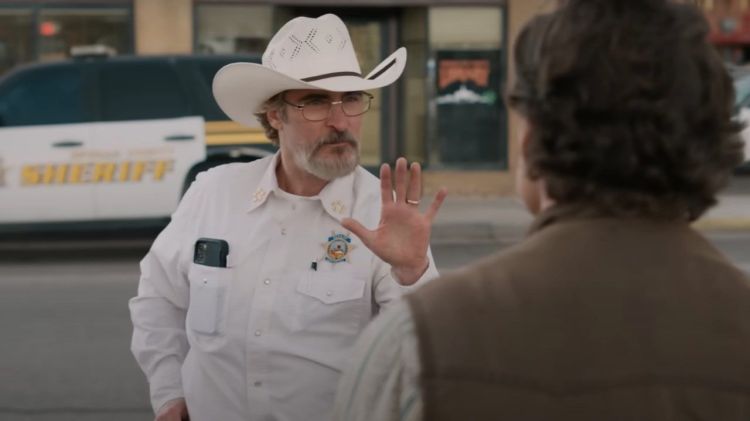
Visually, Eddington commits to its western aesthetic. There are sun-bleached roads, diner booths, cowboy hats that don’t feel ironic, and the twang-laced score that’s probably the most memorable part of the whole experience. You can feel the influence of Leone and early Coens, especially in the deadpan tension or those rare, rapid-cut chase sequences that evoke a ‘60s spaghetti western reel.
And yet, this isn’t a western in spirit. It’s a political fable dressed up in genre drag. The movie focuses on a small-town man named Cross (Joaquin Phoenix), whose disdain for public health mandates pushes him into the local political spotlight. What starts as one man’s defiance spirals outward as national unrest-protests, conspiracy theorists, and social media warfare invades his community.
In theory, that could work. There’s a power in showing how ideology can rot a town from the inside out. But Eddington never fully commits to the emotion beneath the events. There’s no sense of urgency, no spark. It’s all metaphor, no momentum.
Characters Without Anchors
Phoenix is solid, but Cross feels like a concept more than a character. He’s not compellingly awful like Hereditary’s Annie, nor is he vulnerable or unknowable like Beau. He’s just there, drifting through scenes with vague discontent and a cowboy drawl.
The supporting cast isn’t much stronger. Pedro Pascal appears briefly, and while his presence should electrify, it barely registers. But unlike Aster’s usual operatic flair, everyone here just feels like an archetype. They’re placeholders, emblems of ideologies rather than people we’re meant to care about or even fear. By the third act, I wasn’t rooting for or against anyone. I was just waiting for something, anything, to matter.

Even the movie’s attempt at discomfort, its stabs at horror or surrealism, never land. There’s none of the dread-soaked tension that defined Aster’s earlier work. Instead, the horror is sociopolitical. Not in a Get Out or The Babadook way, where metaphor drives the narrative, but more like “Remember how terrible 2020 was?” Yeah. But we’ve moved on.
Eddington’s central problem may be its timing. A story set in the early days of the pandemic when misinformation, fear, and performative politics ruled the day would have landed harder a couple years ago. Back then, the wounds were fresh. The questions were louder. Now, in 2025, we’ve lived through those shocks and moved into new ones.
Which doesn’t mean we shouldn’t look back. But Eddington doesn’t illuminate anything. It doesn’t recontextualize. It just… replays. It’s like a friend who brings up an old fight out of nowhere. You’re not mad, you’re just confused why they’re still fixated on it.
The lack of timing, combined with the lack of narrative propulsion, makes Eddington feel longer than it is. It’s a slow burn that never quite sparks. You feel the runtime. You feel the patience it asks of you. But little else.
The Aster of It All
To be fair, there’s something admirable about a director refusing to repeat himself. Eddington doesn’t rehash Midsommar’s cultish trauma or Hereditary’s supernatural dread. It tries something new. It stretches. It experiments.
But experimentation alone doesn’t make a good movie. Eddington feels more like a collage of ideas than a coherent vision. Pandemic anxiety, media outrage, culture war theater. It’s all in there. But without a center, without a single emotional throughline, it just becomes noise. Slow, quiet, competently shot noise.

Aster may have been aiming for a new kind of horror, one rooted in disillusionment and decay. That’s a worthy goal. But Eddington doesn’t provoke fear or catharsis. Only indifference. And for a filmmaker whose work usually cuts to the bone, that’s the most surprising twist of all.
The one thing that Eddington does nail though, is its atmosphere. The sense of isolation. The wide, empty streets. The sound of the slide guitar echoing into nothing. It’s one of the few elements that lingers after the credits roll.
It got me thinking: maybe Aster has a great western in him. Maybe this was a trial run, a genre sketchbook. If that’s the case, I’ll be there for the next one. Curious, hopeful, and always ready to be wrecked.
But Eddington? This one missed. And not in a bold, fascinating way. Just in a quiet, unmemorable one.
 That Nerd Zach